“I Am a Black Woman” by Mari Evans Complete Analysis
Read the poem before the analysis
I am a black woman
the music of my song
some sweet arpeggio of tears
is written in a minor key
and I
can be heard humming in the night
Can be heard
humming
in the night
I saw my mate leap screaming to the sea
and I/with these hands/cupped the lifebreath
from my issue in the canebrake
I lost Nat's swinging body in a rain of tears
and heard my son scream all the way from Anzio
for Peace he never knew....I
learned Da Nang and Pork Chop Hill
in anguish
Now my nostrils know the gas
and these trigger tire/d fingers
seek the softness in my warrior's beard
I am a black woman
tall as a cypress
strong
beyond all definition still
defying place
and time
and circumstance
assailed
impervious
indestructible
Look
on me and be
renewed
“I Am a Black Woman” by Mari Evans is not just a poem but also a declaration. From the very first line, the speaker doesn’t ask to be seen or understood. She states who she is, clearly and boldly.
But this poem doesn't stop there, it goes deeper than just identity.
It carries history, pain, survival, and power all in one voice.
As you read, you notice something important: the speaker is not just one woman. She becomes many women across time—a mother, a witness, a survivor of war, loss, and struggle. The poem moves through different moments, almost like memories stitched together, showing what it has meant—and still means—to live as a Black woman in a harsh and changing world.
Yet even with all that pain, the poem does not end in weakness.
It rises.
That’s what makes this poem powerful. It shows suffering without surrender.
How we’ll break it down
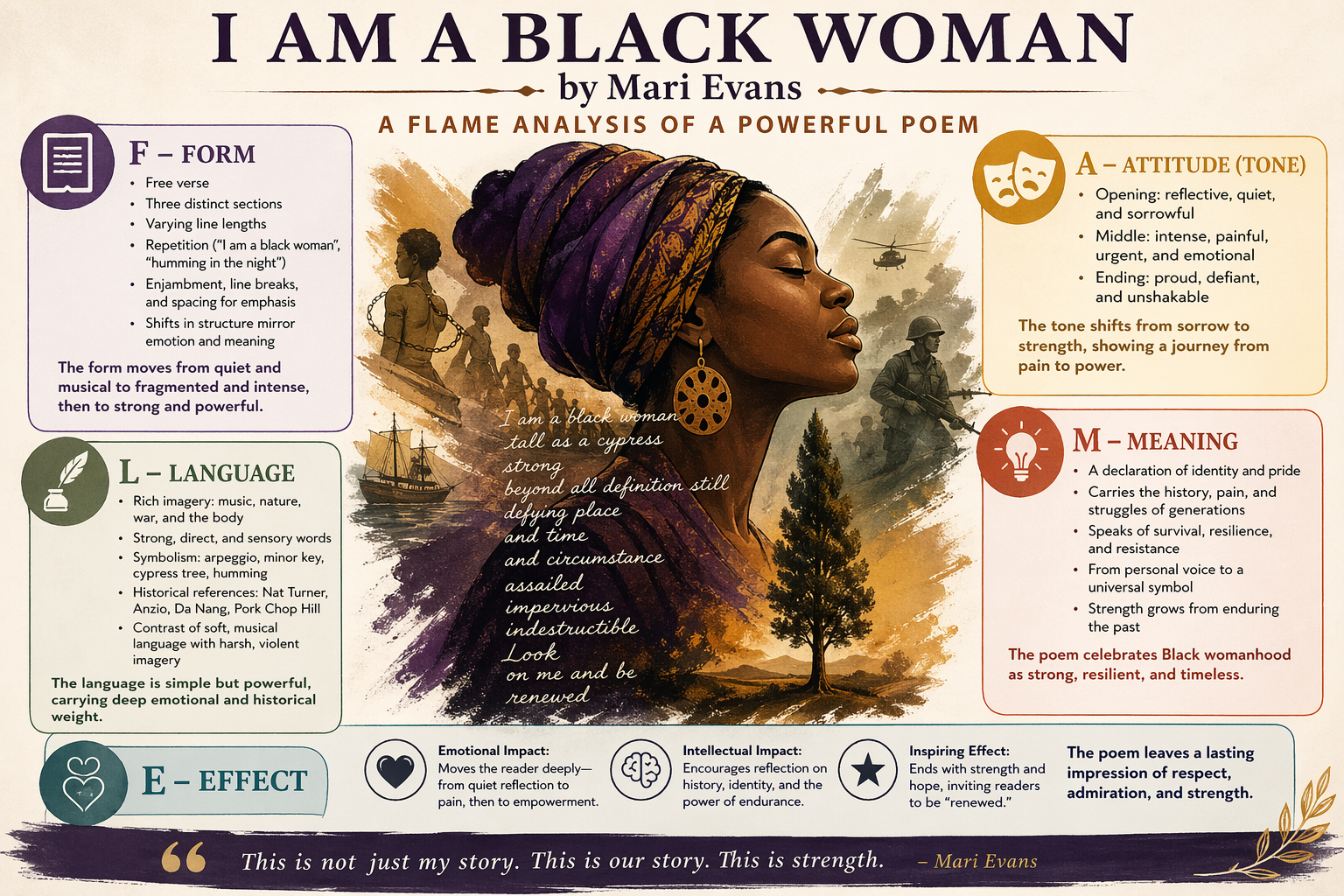
To really understand this poem, we’re going to analyze it section by section using the FLAME framework:
- Form – how each section is built
- Language – the words and images used
- Attitude – the tone and emotions
- Meaning – what each part is saying
- Effect – how it impacts you as a reader
This way, instead of just reading the poem, you’ll actually see how it works—and why it hits so hard.
Let’s start with the first section, where the voice begins quietly… but already carries something heavy.
Form Analysis of “I Am a Black Woman” by Mari Evans
Understanding the form of this poem helps you see how meaning is built—not just through words, but through structure, spacing, and sound. Mari Evans doesn’t follow strict rules here. Instead, she shapes the poem to match the emotion and history it carries.
What Is the Form of the Poem?
“I Am a Black Woman” is written in free verse.
That means:
- There is no fixed rhyme scheme
- No strict rhythm or meter
- Line lengths vary
👉 This gives the poet freedom to control pace, emphasis, and emotion without being restricted.
Section-Based Structure
The poem is divided into three main sections, and each one feels different in rhythm and purpose.
1. Opening Section — Slow, Musical, Reflective
- Short to medium lines
- Repetition of “humming”
- A soft, almost lyrical flow
👉 This part feels like a quiet song or echo in the night.
2. Middle Section — Fast, Broken, Intense
- Longer, more packed lines
- Sudden breaks using slashes ( / )
- Names and places appear quickly (historical references)
👉 The structure becomes fragmented and rushed, reflecting chaos, pain, and memory.
3. Final Section — Strong, Vertical, Commanding
- Very short lines (sometimes one word)
- Words stacked on top of each other
- Clear, bold ending
👉 The structure slows down again, but now it feels powerful and controlled, like a statement.
Use of Repetition (Structural Emphasis)
Repetition plays a big role in the poem’s form.
Key examples:
- “I am a black woman” (appears more than once)
- “humming in the night”
👉 This repetition:
- Anchors the poem
- Reinforces identity
- Creates rhythm even without rhyme
It’s like a heartbeat running through the poem.
Line Breaks and Enjambment
Mari Evans uses line breaks intentionally.
- Some sentences are split across lines (enjambment)
- Some lines stand alone for emphasis
Example:
- “Can be heard
humming
in the night”
👉 Breaking the phrase this way:
- Slows the reader down
- Makes each word feel heavier
- Builds a quiet, echo-like rhythm
Irregular Spacing and Punctuation
Notice:
- Slashes ( / ) in the middle section
- Ellipsis (“…”)
- Unusual spacing
👉 These choices:
- Show interrupted thoughts and memories
- Reflect emotional intensity
- Make the poem feel less controlled—more real
Sound and Rhythm Without Rhyme
Even without rhyme, the poem still has rhythm.
How?
- Repetition
- Word placement
- Sound patterns (like “humming”)
👉 This creates a musical quality, especially in the first section.
Visual Shape of the Poem
If you look at the poem on a page:
- It shrinks and expands
- Some parts feel dense, others open
- The final section looks almost like a pillar or rising shape
👉 This visual form mirrors the journey:
- From quiet expression
- Through chaos and history
- To strength and elevation
Why the Form Matters
The form isn’t random—it reflects the message.
- Free verse = freedom of identity and voice
- Broken structure = pain, history, struggle
- Short final lines = strength, clarity, control
👉 In simple terms:
The way the poem is built matches what the poem is saying.
Quick Summary (for clarity)
- Poem type: Free verse
- Structure: Three-part progression
- Techniques: Repetition, enjambment, spacing, fragmentation
- Effect: Builds emotion, reflects history, emphasizes strength
Next, we’ll move into Language—where the images, symbols, and word choices bring the poem to life.
Great—let’s move into the next part.
Language Analysis of “I Am a Black Woman” by Mari Evans
If form is how the poem is built, language is what gives it life. In this poem, Mari Evans chooses words that are simple on the surface, but deeply loaded with history, emotion, and meaning.
Word Choice
One of the first things you notice is that the language is not complicated.
- Mostly everyday words
- Short, direct phrases
- Clear statements
But don’t let that fool you.
👉 The simplicity makes the message stronger and more direct. There’s no hiding, no confusion—just truth.
Musical Imagery
The opening lines introduce music:
“the music of my song
some sweet arpeggio of tears
is written in a minor key”
Key ideas here:
- “Arpeggio” – a musical term where notes are played one after another
- “Minor key” – often used in sad or emotional music
👉 This suggests:
- Her life is like a song
- That song carries sadness and pain, but also beauty
It sets a tone that is both emotional and expressive.
Repeated Image
This phrase appears more than once:
“Can be heard humming in the night”
This image suggests:
- Quiet strength
- Survival even in darkness
- A voice that continues, even when not seen
👉 It feels soft, but it’s also persistent and unbreakable.
Violent and Historical Imagery
In the middle section, the language shifts sharply.
We see lines like:
- “leap screaming to the sea”
- “cupped the lifebreath”
- “lost Nat’s swinging body”
- “heard my son scream”
These images are:
- Painful
- Direct
- Hard to ignore
They refer to real struggles:
- Slavery
- Violence
- War
👉 The language becomes heavier and more intense, showing lived and inherited pain.
Use of Specific Names and Places
The poem includes references like:
- Nat (likely Nat Turner)
- Anzio
- Da Nang
- Pork Chop Hill
These are tied to:
- Rebellion against slavery
- World War II
- The Vietnam War
👉 This does something powerful:
- It connects one woman’s voice to global and historical events
- It shows that her identity carries generations of experience
Physical and Sensory Language
The poem uses the body in strong ways:
- “these hands”
- “nostrils know the gas”
- “trigger-tired fingers”
These details make the poem feel:
- Real and physical
- Not just emotional, but lived
👉 You don’t just read the poem—you feel it.
Symbolism: Nature and Strength
In the final section, the language shifts again:
“tall as a cypress
strong beyond all definition”
The cypress tree is important:
- Tall
- Deep-rooted
- Long-lasting
👉 This symbol shows:
- Strength
- Endurance
- Growth over time
Words of Power and Resistance
Look at the final words:
- “defying”
- “impervious”
- “indestructible”
- “renewed”
These are strong, confident words.
👉 The language now:
- Rejects weakness
- Declares survival
- Claims power
Contrast in Language (Very Important)
Across the poem, the language shifts:
- Soft → Violent → Strong
- Musical → Historical → Defiant
👉 This contrast shows a journey:
- From quiet expression
- Through pain and memory
- To strength and identity
Why the Language Matters
Mari Evans uses language to:
- Turn personal experience into something universal
- Connect past and present
- Show both pain and power
The words are not fancy—but they are chosen with purpose.
Quick Summary
- Style: Simple, direct, but deeply meaningful
- Imagery: Musical, violent, historical, and natural
- Techniques: Symbolism, contrast, repetition
- Effect: Makes the poem emotional, real, and powerful
Next, we’ll explore Attitude (Tone)—how the speaker feels, and how that feeling changes across the poem.
Attitude (Tone) Analysis of “I Am a Black Woman” by Mari Evans
The attitude, or tone, is how the speaker feels—and how that feeling comes across to the reader. In this poem, the tone is not just one thing. It shifts across the sections, showing a journey through emotion, memory, and strength.
Overall Tone
Instead of staying the same, the tone moves through three main stages:
- Quiet and reflective
- Painful and intense
- Strong and defiant
👉 This shift is important because it mirrors the speaker’s experience—from inner emotion to outward power.
Opening Section
At the start, the tone feels:
- Soft
- Thoughtful
- Slightly sad
Words linked to music and “humming in the night” create a calm, almost private feeling.
👉 It’s like the speaker is:
- Speaking to herself
- Or being heard quietly in the background
Even here, though, there’s strength beneath the softness.
Middle Section
The tone then changes sharply.
It becomes:
- Urgent
- Emotional
- Overwhelming
The references to loss, violence, and war make the tone feel heavy and raw.
👉 You can sense:
- Grief
- Anger
- Exhaustion
This section feels less controlled, as if the speaker is reliving painful memories all at once.
Final Section
In the last section, the tone rises into something powerful.
It becomes:
- Confident
- Defiant
- Proud
Words like “indestructible” and “defying” show a speaker who is no longer just remembering pain—but standing above it.
👉 This is where the poem makes its strongest statement:
- The speaker knows her worth
- She cannot be broken
Contrast in Tone (Why It Matters)
The shift in tone is not random.
- The quiet beginning draws you in
- The intense middle makes you feel the weight of history
- The strong ending leaves you with power and hope
👉 Without this contrast, the poem would not hit as hard.
Tone vs. Message
Even when the tone is sad or painful, the message is never weak.
- The sadness shows what has been endured
- The strength shows what has survived
👉 So the tone and meaning work together:
pain is acknowledged, but strength wins in the end.
Quick Summary
- Opening tone: Quiet, reflective, slightly sorrowful
- Middle tone: Intense, painful, overwhelming
- Final tone: Proud, strong, defiant
- Overall effect: Builds emotional depth and ends with power
Next, we’ll move into Meaning—what the poem is really saying at its core, and the big ideas it leaves you with.
Meaning of “I Am a Black Woman” by Mari Evans
Now we come to the core of the poem—what it truly means. While the language and tone show us how the poem feels, the meaning tells us what it’s saying underneath it all.
This poem is not just about one person. It speaks on identity, history, survival, and power—all at once.
Central Message
At its heart, the poem is a declaration:
👉 “I am a Black woman” is not just a statement—it’s a claim of power.
The speaker is saying:
- She knows who she is
- She accepts it fully
- She is proud of it
There is no apology or hesitation.
Identity as Something Deep and Layered
The poem shows that identity is not simple.
The speaker is:
- An individual
- A voice shaped by history
- A symbol of many generations
👉 This means being a Black woman is not just personal—it carries cultural and historical weight.
The Weight of History
The middle section brings in different moments of pain:
- Slavery
- Violence
- War
These are not random.
👉 They show that the speaker carries:
- The suffering of the past
- The struggles of different generations
It’s like her identity stretches across time.
Pain as Part of the Experience
The poem does not hide suffering.
It shows:
- Loss
- Fear
- Trauma
But here’s the key:
👉 The poem does not let pain define her completely.
Instead, it shows pain as something she has endured and survived.
Survival and Resilience
Despite everything, the speaker stands strong.
Words like:
- “impervious”
- “indestructible”
show that she cannot be broken.
👉 The meaning shifts from:
- What has been done to her
to - What she has become despite it
From One Voice to Many
Even though the poem uses “I,” it feels larger than one person.
👉 The speaker becomes:
- A mother
- A witness
- A survivor
- A symbol of Black womanhood
This makes the poem both personal and universal.
Defiance and Self-Definition
One of the strongest ideas in the poem is this:
👉 She defines herself—not society, not history, not others.
Words like:
- “defying”
- “indestructible”
show resistance.
She refuses to be:
- Limited
- Silenced
- Reduced
Renewal and Power
The final line invites the reader:
“Look on me and be renewed”
This is powerful.
👉 It means:
- Her strength can inspire others
- Her survival becomes a source of hope
The poem doesn’t just tell a story—it offers strength to the reader.
Big Ideas (Themes)
Here are the main themes clearly:
- Identity and pride
- History and memory
- Pain and survival
- Strength and resilience
- Defiance and self-definition
Why the Meaning Matters
This poem matters because it:
- Gives voice to experiences often ignored
- Turns pain into power
- Shows strength without denying struggle
👉 It reminds us that identity is not just about who you are—it’s about what you carry and how you rise.
Quick Summary
- Main message: Proud, powerful identity shaped by history
- Core idea: Survival through pain leads to strength
- Final takeaway: The speaker stands strong and invites others to do the same
Next, we’ll finish with Effect—how this poem impacts the reader and why it stays with you long after reading.
Effect of “I Am a Black Woman” by Mari Evans
The effect of a poem is what it does to you as a reader—how it makes you feel, think, and respond. This is where everything comes together: form, language, tone, and meaning.
In this poem, the effect is strong, lasting, and hard to ignore.
Immediate Emotional Impact
From the start, the poem pulls you in quietly.
The soft, musical opening makes you slow down and listen.
But then—
👉 The middle section hits hard with pain, history, and intensity.
You don’t just read it—you feel the weight of it.
- The suffering feels real
- The memories feel close
- The emotion feels heavy
A Shift from Discomfort to Strength
The poem creates a powerful emotional journey:
- First, you feel calm curiosity
- Then, discomfort and sadness
- Finally, strength and admiration
👉 This shift is important.
It doesn’t leave you stuck in pain—it lifts you out of it.
Makes the Reader Think Deeper
The poem pushes you to think about:
- What identity really means
- How history shapes people
- The strength behind survival
👉 It’s not just emotional—it’s thought-provoking.
You start to see the speaker as more than one person.
You begin to understand the layers behind her voice.
Inspires Strength and Respect
By the end, the speaker stands tall and unshaken.
This creates a strong effect on the reader:
- You feel respect
- You feel admiration
- You feel inspired
👉 The line:
“Look on me and be renewed”
almost feels like a challenge—and an invitation.
Creates Connection
Even if the reader has not lived the same experiences, the poem still connects.
Why?
Because it deals with:
- Struggle
- Identity
- Survival
👉 These are universal human experiences.
The poem builds empathy without forcing it.
Stays With the Reader
This is the kind of poem that lingers.
- Certain lines echo in your mind
- The final message feels strong
- The emotional journey is memorable
👉 That lasting impact is part of its power.
Why the Effect Matters
The poem doesn’t just tell a story—it leaves a mark.
It:
- Makes you feel deeply
- Makes you think critically
- Leaves you with strength, not defeat
👉 In simple terms:
you finish the poem feeling stronger than when you started.
Quick Summary
- Emotional effect: Moves from quiet to intense to powerful
- Mental effect: Encourages deeper thinking about identity and history
- Final impact: Inspires strength, respect, and reflection
Final Thought
“I Am a Black Woman” by Mari Evans doesn’t just speak—it resonates.
It reminds the reader that even through pain and history,
strength can rise, stand firm, and even inspire others.
FAQs
Here are clear, helpful answers to common questions readers often have about this poem.
What is the main message of “I Am a Black Woman”?
The main message is about identity, strength, and survival.
The speaker proudly declares who she is while showing that her identity is shaped by history, pain, and resilience.
👉 In simple terms:
She has faced struggle, but she remains strong and unbreakable.
What does “I am a Black woman” symbolize in the poem?
It’s more than a statement—it’s a powerful declaration.
It symbolizes:
- Pride in identity
- Self-acceptance
- Refusal to be defined by others
👉 It’s the speaker claiming her place in the world.
Why does the tone change throughout the poem?
The tone changes to reflect different experiences:
- Soft and reflective at the start
- Painful and intense in the middle
- Strong and confident at the end
👉 This shift shows a journey from memory and struggle to strength and power.
What is the significance of the historical references?
The poem mentions events and figures linked to:
- Slavery
- War
- Violence
👉 These references show that the speaker carries generations of history, not just her own personal story.
What does the “cypress tree” represent?
The cypress tree symbolizes:
- Strength
- Endurance
- Deep roots
👉 It shows that the speaker is strong, grounded, and able to withstand hardship.
Is the poem about one person or many?
Even though the poem uses “I,” it represents more than one person.
👉 The speaker becomes a voice for:
- Many Black women
- Different generations
- Shared experiences
Why is the poem written in free verse?
Free verse allows the poet to:
- Express emotion freely
- Control pacing and emphasis
- Reflect real thoughts and memories
👉 It makes the poem feel more natural and powerful.
What emotions does the poem create in the reader?
The poem takes the reader through different emotions:
- Calm and curiosity
- Sadness and discomfort
- Strength and inspiration
👉 By the end, most readers feel respect and admiration.
What does the final line mean: “Look on me and be renewed”?
This line is both a statement and an invitation.
👉 It means:
- Her strength can inspire others
- Her survival offers hope
It leaves the reader with a feeling of renewal and empowerment.
Why is this poem still relevant today?
The poem remains important because it deals with:
- Identity
- Equality
- Strength through struggle