How to Write a Haiku

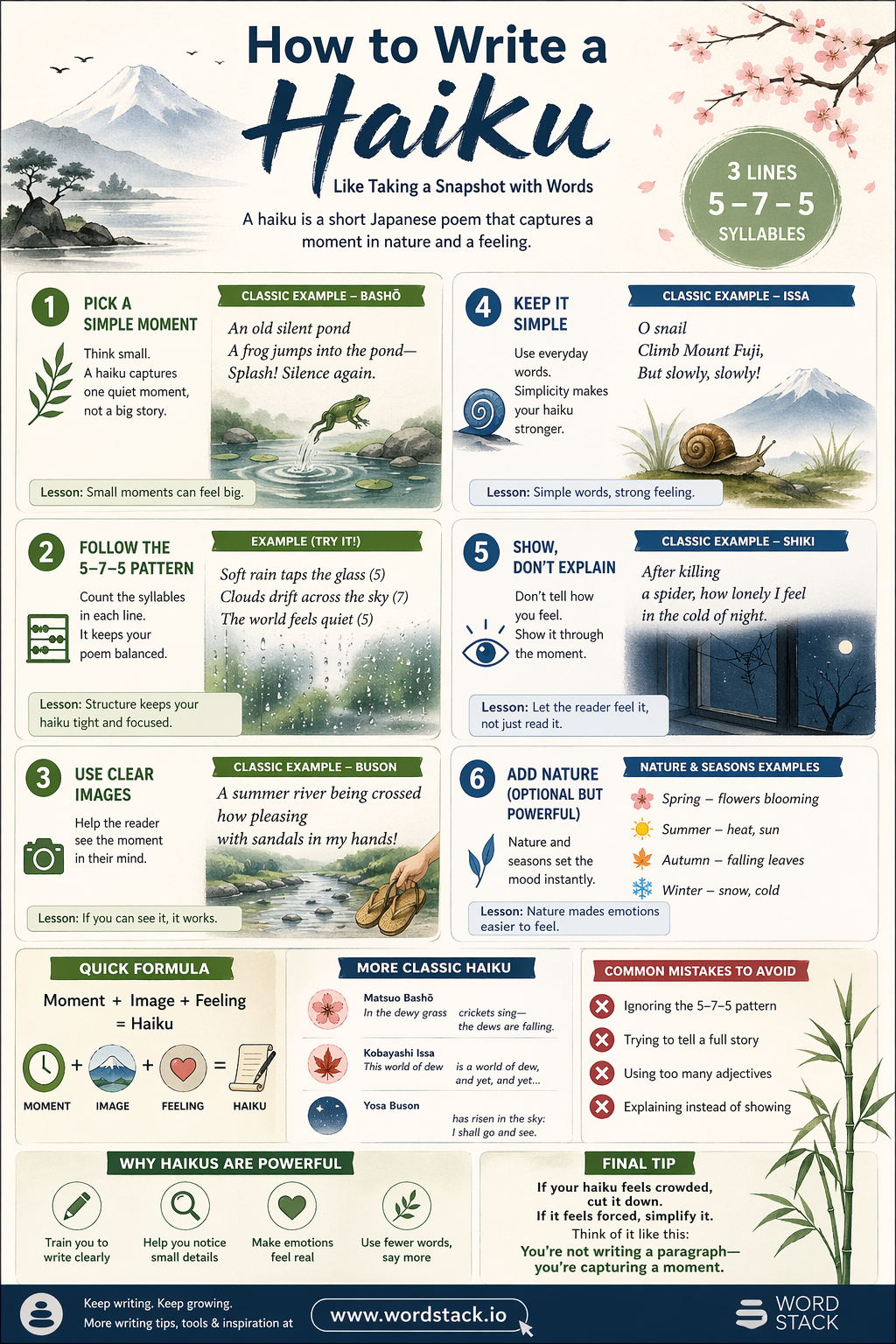
Writing a haiku is like capturing a tiny moment in time. No long stories. No extra noise. Just one clear feeling, frozen in words.
And the best way to learn? See how the masters did it.
What Is a Haiku?
A haiku is a short poem from Japan. It focuses on simple moments—usually in nature.
It has 3 lines:
- 5 syllables
- 7 syllables
- 5 syllables
Short. Clean. Powerful.
Step 1: Pick a Simple Moment
Think small, not big.
A haiku doesn’t try to explain life. It just shows one moment.
Classic example — Matsuo Bashō:
An old silent pond
A frog jumps into the pond—
Splash! Silence again.
Nothing complicated here. Just a pond, a frog, and a sound. But it feels alive.
Step 2: Follow the 5–7–5 Pattern
Count the beats (syllables) in each line.
Example inspired by the style:
Soft rain taps the glass (5)
Clouds drift across the gray sky (7)
The world feels quiet (5)
Step 3: Use Clear Images
Let the reader see the moment.
Classic example — Yosa Buson:
A summer river being crossed
how pleasing
with sandals in my hands!
You can picture this instantly—someone walking through water, relaxed.
Step 4: Keep It Simple
No need for fancy words.
Classic example — Kobayashi Issa:
O snail
Climb Mount Fuji,
But slowly, slowly!
It’s almost playful. But it still carries meaning.
Step 5: Show, Don’t Explain
Don’t say the emotion—let the image reveal it.
Classic example — Masaoka Shiki:
After killing
a spider, how lonely I feel
in the cold of night.
He doesn’t explain much. But you feel the loneliness.
Step 6: Add Nature (Optional but Powerful)
Most classic haiku connect to nature or seasons.
You’ve already seen it:
- Pond and frog (Bashō)
- River (Buson)
- Snail and mountain (Issa)
Quick Formula to Remember
Moment + Image + Feeling = Haiku
Try It Yourself
Here’s a simple one:
Morning sunlight spills
Across the quiet bedroom
A new day begins
Common Mistakes to Avoid
- Trying to tell a full story
- Using too many words
- Ignoring the 5–7–5 pattern
- Explaining instead of showing
Why Haikus Work So Well
Haikus are short, but they stay with you.
Even the classics we saw:
- A frog jumping
- A person crossing a river
- A snail climbing
- A quiet lonely night
Nothing “big”… but they still hit.
That’s the power.
Final Tip
If your haiku feels crowded, cut it down.
If it feels forced, simplify it.
Think of it like this:
You’re not writing a paragraph—you’re capturing a moment.