The Raven: A Dark Tale of Grief and Madness Explained
A simple, clear analysis of The Raven by Edgar Allan Poe, breaking down its meaning, themes, symbolism, and emotional depth.

Read the poem before the analysis
Once upon a midnight dreary, while I pondered, weak and weary,
Over many a quaint and curious volume of forgotten lore,
While I nodded, nearly napping, suddenly there came a tapping,
As of some one gently rapping, rapping at my chamber door. “
“'Tis some visitor,” I muttered, “tapping at my chamber door—
Only this, and nothing more.”
Ah, distinctly I remember it was in the bleak December,
And each separate dying ember wrought its ghost upon the floor.
Eagerly I wished the morrow;—vainly I had sought to borrow
From my books surcease of sorrow—sorrow for the lost Lenore—
For the rare and radiant maiden whom the angels name Lenore—
Nameless here for evermore.
And the silken sad uncertain rustling of each purple curtain
Thrilled me—filled me with fantastic terrors never felt before;
So that now, to still the beating of my heart, I stood repeating, “
“'Tis some visitor entreating entrance at my chamber door—
Some late visitor entreating entrance at my chamber door;—
This it is, and nothing more.”
Presently my soul grew stronger; hesitating then no longer,
“Sir,” said I, “or Madam, truly your forgiveness I implore;
But the fact is I was napping, and so gently you came rapping,
And so faintly you came tapping, tapping at my chamber door,
That I scarce was sure I heard you”—here I opened wide the door;—
Darkness there, and nothing more.
Deep into that darkness peering, long I stood there wondering, fearing,
Doubting, dreaming dreams no mortals ever dared to dream before;
But the silence was unbroken, and the stillness gave no token,
And the only word there spoken was the whispered word, “Lenore!”
This I whispered, and an echo murmured back the word, “Lenore!”—
Merely this, and nothing more.
Back into the chamber turning, all my soul within me burning,
Soon again I heard a tapping somewhat louder than before.
“Surely,” said I, “surely that is something at my window lattice,
Let me see, then, what thereat is, and this mystery explore—
Let my heart be still a moment and this mystery explore;—
'Tis the wind and nothing more.”
Open here I flung the shutter, when, with many a flirt and flutter,
In there stepped a stately raven of the saintly days of yore.
Not the least obeisance made he; not a minute stopped or stayed he;
But, with mien of lord or lady, perched above my chamber door—
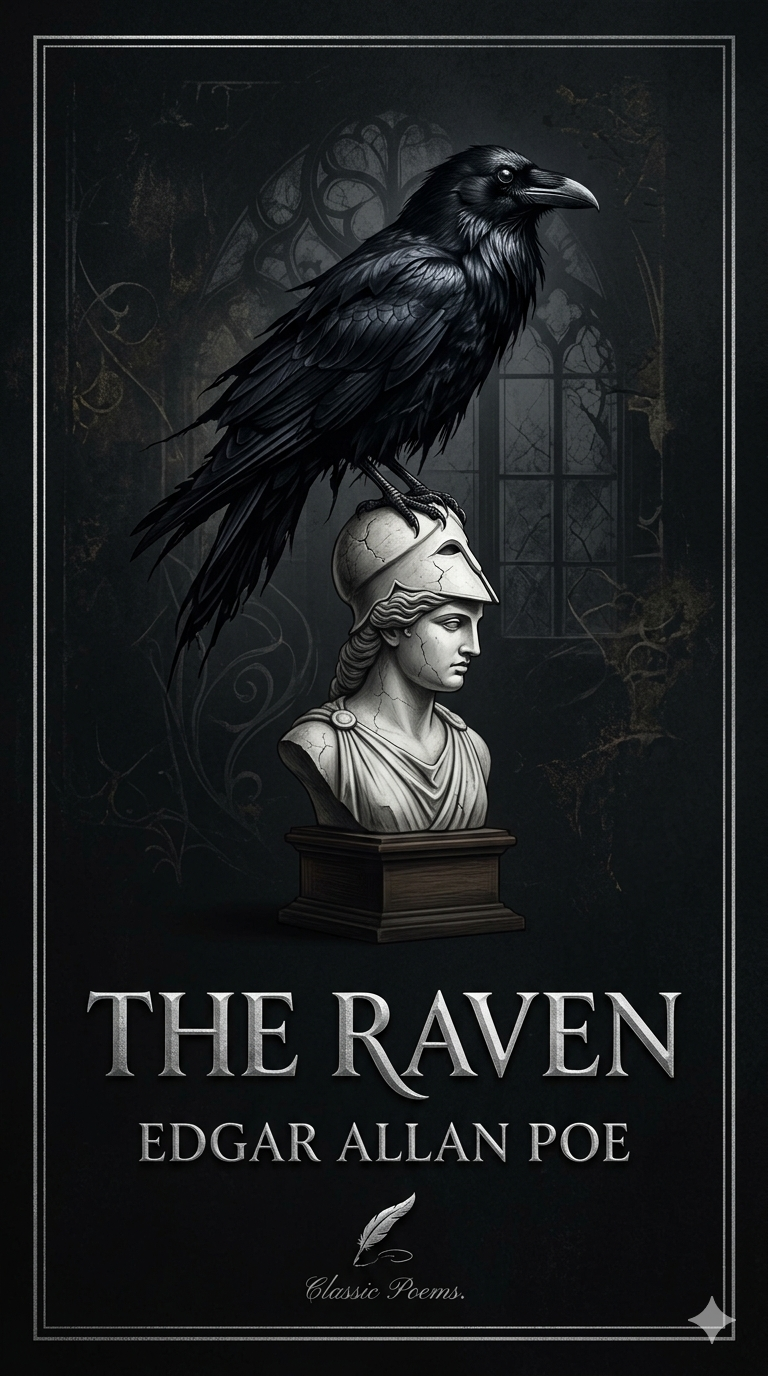
Perched upon a bust of Pallas just above my chamber door—
Perched, and sat, and nothing more.
Then this ebony bird beguiling my sad fancy into smiling,
By the grave and stern decorum of the countenance it wore.
“Though thy crest be shorn and shaven, thou,” I said, “art sure no craven,
Ghastly grim and ancient raven wandering from the Nightly shore—
Tell me what thy lordly name is on the Night's Plutonian shore!”
Quoth the Raven, “Nevermore.”
Much I marvelled this ungainly fowl to hear discourse so plainly,
Though its answer little meaning—little relevancy bore;
For we cannot help agreeing that no living human being
Ever yet was blest with seeing bird above his chamber door—
Bird or beast upon the sculptured bust above his chamber door,
With such name as “Nevermore.”
But the Raven, sitting lonely on the placid bust, spoke only
That one word, as if his soul in that one word he did outpour.
Nothing further then he uttered—not a feather then he fluttered—
Till I scarcely more than muttered, “other friends have flown before—
On the morrow he will leave me, as my hopes have flown before.”
Then the bird said, “Nevermore.”
Startled at the stillness broken by reply so aptly spoken,
“Doubtless,” said I, “what it utters is its only stock and store,
Caught from some unhappy master whom unmerciful Disaster
Followed fast and followed faster till his songs one burden bore—
Till the dirges of his Hope that melancholy burden bore,
Of ‘Never—nevermore’.”
But the Raven still beguiling my sad fancy into smiling,
Straight I wheeled a cushioned seat in front of bird and bust and door;
Then, upon the velvet sinking, I betook myself to linking
Fancy unto fancy, thinking what this ominous bird of yore—
What this grim, ungainly, ghastly, gaunt, and ominous bird of yore
Meant in croaking “Nevermore.”
This I sat engaged in guessing, but no syllable expressing
To the fowl whose fiery eyes now burned into my bosom's core;
This and more I sat divining, with my head at ease reclining
On the cushion's velvet lining that the lamplight gloated o'er,
But whose velvet violet lining with the lamplight gloating o'er,
She shall press, ah, nevermore!
Then, methought, the air grew denser, perfumed from an unseen censer
Swung by Seraphim whose footfalls tinkled on the tufted floor.
“Wretch,” I cried, “thy God hath lent thee—by these angels he hath sent thee
Respite—respite and nepenthe, from thy memories of Lenore;
Quaff, oh quaff this kind nepenthe and forget this lost Lenore!”
Quoth the Raven, “Nevermore.”
“Prophet!” said I, “thing of evil!—prophet still, if bird or devil!—
Whether Tempter sent, or whether tempest tossed thee here ashore,
Desolate yet all undaunted, on this desert land enchanted—
On this home by horror haunted—tell me truly, I implore—
Is there—is there balm in Gilead?—tell me—tell me, I implore!”
Quoth the Raven, “Nevermore.”
“Prophet!” said I, “thing of evil!—prophet still, if bird or devil!
By that Heaven that bends above us—by that God we both adore—
Tell this soul with sorrow laden if, within the distant Aidenn,
It shall clasp a sainted maiden whom the angels name Lenore—
Clasp a rare and radiant maiden whom the angels name Lenore.”
Quoth the Raven, “Nevermore.”
“Be that word our sign in parting, bird or fiend!” I shrieked, upstarting—
“Get thee back into the tempest and the Night's Plutonian shore!
Leave no black plume as a token of that lie thy soul hath spoken!
Leave my loneliness unbroken!—quit the bust above my door!
Take thy beak from out my heart, and take thy form from off my door!”
Quoth the Raven, “Nevermore.”
And the Raven, never flitting, still is sitting, still is sitting
On the pallid bust of Pallas just above my chamber door;
And his eyes have all the seeming of a demon's that is dreaming,
And the lamplight o'er him streaming throws his shadow on the floor;
And my soul from out that shadow that lies floating on the floor
Shall be lifted—nevermore!
The Raven is one of the most famous poems ever written in English literature. Written by Edgar Allan Poe, it is a dark, emotional story about grief, memory, and mental collapse.The poem follows a man who is mourning the loss of his loved one, Lenore. One night, a mysterious raven enters his room and begins to repeat a single word: “Nevermore.”
What starts as curiosity slowly turns into emotional torture. At its heart, The Raven is not just about a bird—it is about a mind breaking under grief.
Summary of The Raven by Edgar Allan Poe
“The Raven” is about a man who is sad and lonely late at night, thinking about his lost love, Lenore. While he is reading and trying to distract himself, he hears a tapping at his door, and then at his window. When he opens the window, a black raven flies in and sits on a statue above his door.
At first, the man is curious and even amused by the bird. But when he asks the raven questions, the bird only replies with one word: “Nevermore.”
As the man keeps asking deeper and more emotional questions—about love, hope, and whether he will ever see Lenore again—the raven keeps saying “Nevermore.” This makes the man feel worse and worse. He starts to believe the bird is a sign that he will never escape his sadness.
By the end, the man feels trapped in his grief. The raven stays sitting above him, and the man believes his soul will never be free from the pain of losing Lenore.
Analysis of The Raven
Edgar Allan Poe builds this poem as a slow mental breakdown, not just a strange visit from a bird. The focus is less on what happens, and more on how the speaker reacts to it.
At the start, the speaker is already weak. He is tired, alone, and thinking about Lenore. This matters because it shows his mind is not stable even before the raven appears. The tapping sound creates tension, but it also shows how easily his thoughts can be disturbed.
When the raven enters, it brings a shift. The bird itself does nothing complex—it only says “Nevermore.” But the speaker gives that word meaning. At first, he treats the raven lightly, almost like a joke. Soon after, he begins asking emotional questions. This is where the real conflict begins.
The key idea in this poem is that the speaker creates his own suffering. The raven does not explain anything. It does not force answers. The speaker chooses to ask questions that will hurt him, and then accepts the bird’s repeated answer as truth.
As the poem continues, his questions become deeper:
- First, simple curiosity
- Then, questions about relief from pain
- Finally, questions about seeing Lenore again
Each time, “Nevermore” feels heavier. The word does not change—but its meaning grows darker because of the speaker’s emotional state.
This shows how grief works. When someone is stuck in loss, even neutral things can feel negative. The raven becomes a symbol of that—constant, unmoving, and impossible to ignore.
By the end, the speaker is fully overwhelmed. He no longer questions the raven. Instead, he believes it represents a permanent truth: that his suffering will never end. The final image of the raven still sitting above the door shows that this feeling is not temporary. It suggests he is trapped in his own mind.
Overall, the poem’s analysis comes down to this:
the horror is not the raven—it is the speaker’s inability to escape his own thoughts.
Themes in The Raven
Now that the speaker’s mental state is clear, the deeper meaning of the poem comes into focus through its themes. Edgar Allan Poe uses these ideas to show not just what the speaker feels—but why it feels so intense and lasting.
Grief and Loss
This is the strongest theme in the poem.
The speaker is not just sad—he is stuck in his grief. Lenore is gone, but his mind keeps returning to her. Every thought leads back to that loss.
What makes this powerful is that the grief does not move forward. It doesn’t heal. Instead, it repeats, just like the raven’s “Nevermore.”
The Power of the Mind
A big part of the poem is about how the mind can shape reality.
The raven only says one word. But the speaker:
- Adds meaning to it
- Builds fear from it
- Turns it into a final truth
This shows how thoughts, especially negative ones, can grow stronger the more we focus on them.
Hopelessness
As the poem continues, hope slowly disappears.
At first, the speaker still searches for comfort. But each “Nevermore” removes a piece of that hope. By the end, he fully believes that nothing will get better.
This theme connects closely with grief—the longer he stays in it, the less he believes in any escape.
Memory and the Past
Lenore is not physically present, but she is everywhere in the speaker’s mind.
The poem shows how memories can:
- Keep someone alive in your thoughts
- But also stop you from moving on
The speaker cannot let go, and that keeps him trapped.
Isolation
The entire poem happens in a quiet, closed space.
The speaker is:
- Alone
- Awake at night
- Lost in his own thoughts
This isolation makes everything feel stronger. There is no one to interrupt his thinking or bring him back to reality.
The Fear of the Unknown
At the start, the tapping creates a sense of mystery.
The speaker does not know what is outside the door or window. That uncertainty builds tension. Even when the raven appears, it does not explain anything—it only deepens the mystery.
This shows how fear often comes from not knowing, and from what we imagine.
The Idea of Fate or Finality
“Nevermore” starts to feel like a final answer to everything.
It suggests:
- No second chances
- No reunion with Lenore
- No escape from pain
Whether or not it is true does not matter—the speaker believes it. That belief makes it feel like fate.
Control vs. Loss of Control
At the beginning, the speaker seems calm and in control.
But slowly:
- His questions become desperate
- His emotions take over
- His thinking becomes fixed and dark
By the end, he is no longer in control of his thoughts. The raven, sitting still, contrasts with the speaker’s unstable mind.
Simple Way to See the Themes Together
All these themes connect in one clear way:
A lonely mind, stuck in grief, can turn a single moment into something overwhelming and permanent.
That’s what makes The Raven powerful—it takes simple elements and shows how deeply they can affect someone from the inside.
Quotes in The Raven
After seeing the themes, the key quotes make everything clearer. Edgar Allan Poe uses short, powerful lines to show the speaker’s emotions and how they change over time.
“Once upon a midnight dreary, while I pondered, weak and weary…”
This is the opening line, and it sets the tone right away.
It shows:
- The speaker is tired and mentally drained
- The setting is dark and quiet
- Something heavy is already on his mind
Before anything even happens, we can tell he is vulnerable. That’s important because it explains why the rest of the poem affects him so deeply.
“Deep into that darkness peering, long I stood there wondering, fearing…”
This line shows the speaker’s fear of the unknown.
He is:
- Looking into darkness
- Waiting
- Letting his imagination grow
Nothing is actually there yet, but his mind is already creating tension. This connects to the theme of how fear often comes from within.
“Quoth the Raven, ‘Nevermore.’”
This is the most famous line in the poem.
At first, it feels simple—even strange. But as the poem continues, it becomes:
- A painful answer
- A symbol of finality
- A voice of hopelessness
The word never changes, but its meaning becomes heavier each time the speaker hears it.
“Nameless here for evermore.”
When the speaker first reacts to the raven, he assumes it will leave like everything else.
This shows:
- His expectation of loss
- His belief that nothing stays
It connects to his grief, where everything meaningful seems temporary.
“Is there balm in Gilead?”
Here, the speaker asks if there is any relief for his pain.
“Balm in Gilead” is a reference to a place known for healing. In simple terms, he is asking:
“Will I ever feel better?”
The raven’s answer—“Nevermore”—turns this moment into one of deep hopelessness.
“Tell this soul with sorrow laden if… it shall clasp a sainted maiden…”
This is one of the most emotional parts of the poem.
The speaker is asking if he will ever see Lenore again in the afterlife. This shows:
- His deep love for her
- His desperation for hope
When the answer is again “Nevermore,” it breaks that last bit of hope he had left.
“And my soul from out that shadow… shall be lifted—nevermore!”
This is the final line, and it brings everything together.
The speaker now believes:
- His soul is trapped
- His sadness will never end
- There is no escape
The raven has not changed—but the speaker has fully accepted the darkest meaning of its word.
Why These Quotes Matter
Each quote shows a step in the speaker’s mental journey:
- From curiosity
- To fear
- To hope
- To complete despair
Put together, they show how a single word, repeated again and again, can slowly take over someone’s thoughts.
That’s what gives The Raven its lasting impact.
Symbols in The Raven
After looking at the key quotes, the poem’s symbols help tie everything together. Edgar Allan Poe uses simple objects and images, but each one carries a deeper meaning connected to the speaker’s thoughts and emotions.
The Raven
The raven is the most important symbol in the poem.
It can represent:
- Endless grief
- A voice of doubt or negativity
- Something that will not leave
The bird never changes. It stays still and repeats “Nevermore.” This makes it feel constant and unmovable—just like the speaker’s sadness by the end.
“Nevermore”
Even though it’s just a word, it works like a symbol.
It stands for:
- Final answers
- No hope
- No second chances
At first, it seems random. But the more the speaker hears it, the more it becomes a symbol of everything he fears.
Lenore
Lenore represents more than a lost person.
She stands for:
- Love that is gone
- The past the speaker cannot return to
- An ideal he can never reach again
She is never physically present in the poem, which makes her feel distant and almost unreal—like a perfect memory the speaker can’t let go of.
The Chamber (Room)
The entire poem takes place in one room.
This room symbolizes:
- The speaker’s mind
- Isolation
- Being trapped with one’s thoughts
Nothing from the outside world enters except the raven. This makes the space feel closed, almost like there is no escape.
The Night and Darkness
The setting is dark and late at night.
This represents:
- Confusion
- Fear
- Emotional heaviness
Nighttime often makes thoughts feel stronger, and here it reflects the speaker’s mental state.
The Bust of Pallas
The raven sits on a statue of Pallas (another name for Athena, the goddess of wisdom).
This is important because:
- Wisdom is supposed to bring clarity
- But the raven (darkness) sits on top of it
This suggests that emotion and grief are overpowering reason. The speaker can no longer think clearly.
The Tapping Sound
The tapping at the door and window starts everything.
It symbolizes:
- A disturbance in the speaker’s mind
- The arrival of something he cannot control
- The shift from calm to anxiety
At first, it feels small—but it leads to everything that follows.
The Shadow
At the end, the raven casts a shadow over the speaker.
This shadow represents:
- Lasting sadness
- A dark mental state
- Something that will not go away
When the speaker says his soul will never escape that shadow, it shows he feels permanently trapped.
Simple Way to Understand the Symbols
All the symbols connect in one clear idea:
The outside objects reflect what is happening inside the speaker’s mind.
The raven, the room, the darkness—they are not just physical things. They mirror his grief, his thoughts, and his growing sense of hopelessness.
Literary Devices Used in The Raven
Now that the symbols are clear, the next layer is how Edgar Allan Poe actually builds the poem. His use of literary devices is what gives The Raven its strong sound, rhythm, and emotional impact.
Rhyme Scheme
The poem has a very tight and musical rhyme pattern.
For example:
- dreary / weary
- napping / tapping
This repeated rhyme creates a hypnotic, almost echo-like effect, which pulls the reader deeper into the poem—just like the speaker gets pulled into his thoughts.
Repetition
Repetition is one of the most powerful tools in the poem.
The best example is:
- “Nevermore”
It is repeated again and again, but each time:
- The meaning grows heavier
- The emotional impact increases
This mirrors how negative thoughts can repeat in the mind and become stronger over time.
Alliteration
Alliteration is when words close together start with the same sound.
Example:
- “weak and weary”
- “silken, sad, uncertain”
This makes the lines sound smoother and more memorable, while also adding to the poem’s mood.
Internal Rhyme
Instead of rhyming only at the end of lines, Poe also adds rhyme within the same line.
Example:
- “Once upon a midnight dreary, while I pondered, weak and weary”
This creates a flowing, musical rhythm that keeps the reader engaged and adds to the poem’s haunting tone.
Imagery
Poe uses strong descriptions to help the reader picture and feel the scene.
We see:
- Dark rooms
- Flickering light
- The black raven
These images build a gloomy and tense atmosphere, matching the speaker’s emotions.
Symbolism
Many objects in the poem carry deeper meanings (as seen earlier).
For example:
- The raven = unending grief
- The darkness = confusion and fear
Symbolism allows the poem to work on both a surface level and a deeper emotional level.
Personification
The raven is given human-like qualities.
It:
- “Speaks”
- Seems to respond to questions
Even though it only says one word, the speaker treats it like it understands him. This shows how far his mind has gone into emotional thinking.
Tone
The tone of the poem changes over time.
It moves from:
- Curious → uneasy → desperate → hopeless
This shift helps the reader follow the speaker’s mental decline.
Meter (Rhythm)
The poem uses a steady, beat-like rhythm (called trochaic octameter).
In simple terms:
- It sounds like a repeated “DA-da” pattern
- This creates a chant-like, almost hypnotic flow
This rhythm makes the poem feel intense and hard to escape—just like the speaker’s thoughts.
Simple Way to See It All
All these devices work together to do one thing:
They make the poem feel as intense and repetitive as the speaker’s mind.
The sound, the rhythm, the repeated words—they all pull you into the same emotional loop the speaker is trapped in.
Historical Context of The Raven
To fully understand the poem, it helps to look at the time it was written. Edgar Allan Poe published The Raven in 1845, during a period when both literature and society were deeply interested in emotion, mystery, and the darker side of life.
The Rise of Dark Romanticism
The Raven is a strong example of Dark Romanticism, a literary movement in the 1800s.
This movement focused on:
- Human weakness and inner struggles
- Guilt, fear, and emotional pain
- The idea that the mind can turn against itself
Unlike regular Romanticism (which often celebrated beauty and nature), Dark Romanticism looked at what happens when emotions become overwhelming.
This is exactly what we see in the narrator—his mind becomes the main source of his suffering.
Interest in Death and Mourning
In the 19th century, death was a more common part of everyday life due to illness and shorter life spans.
Because of this:
- People were more open about grief
- Mourning rituals (like wearing black) were common
- Literature often explored loss and the afterlife
The narrator’s deep sadness over Lenore would have felt very real and relatable to readers at the time.
Poe’s Personal Life
Poe’s own experiences strongly influenced the poem.
He faced:
- The loss of several loved ones
- Long periods of loneliness
- Financial struggles
Most importantly, his wife, Virginia, was very ill and later died young. This personal connection to loss helps explain why the poem’s grief feels so intense and believable.
The Popularity of Gothic Style
The Raven also fits into the Gothic tradition, which was popular at the time.
Gothic elements include:
- Dark settings
- Mysterious events
- Emotional extremes
The poem’s midnight setting, eerie atmosphere, and strange visitor all reflect this style.
Public Reaction at the Time
When The Raven was first published:
- It became very popular quickly
- People were drawn to its rhythm and mood
- Poe gained widespread attention
The poem stood out because it combined strong emotion with a musical, almost unforgettable structure.
Simple Way to Understand the Context
Think of it like this:
The Raven came from a time when people were deeply interested in emotion, loss, and the darker parts of the human mind—and Poe turned all of that into one powerful poem.
Why This Context Matters
Knowing the historical background helps explain:
- Why the poem focuses so much on grief
- Why the tone is dark and intense
- Why readers connected with it so strongly
It shows that The Raven is not just a personal story—it’s also shaped by the ideas and experiences of its time.
Answers to Discussion Questions on The Raven
To take the analysis further, these answers break down the poem in a more direct, question-and-answer way. They focus on character, symbolism, and style, helping you see how everything works together in a clear and connected way.
Character and Plot Analysis
What is the narrator doing at the beginning, and how does his emotional state change?
At the start, the narrator is:
- Sitting alone at night
- Reading to distract himself
- Thinking about Lenore
He is already sad, but still somewhat calm and in control.
By the end:
- He becomes emotionally overwhelmed
- Starts believing in hopeless ideas
- Feels trapped in his grief
His state shifts from tired and sad → anxious → desperate → completely hopeless.
How does the speaker’s attitude toward the raven change?
His attitude goes through clear stages:
- Amusement → He finds the bird strange but slightly entertaining
- Curiosity → He begins asking it questions
- Fear → He starts taking its answers seriously
- Anger and despair → He feels attacked by its presence and meaning
This change shows how his emotions grow stronger over time, even though the raven itself never changes.
Why does the narrator keep asking questions?
Even though he starts to expect “Nevermore,” he keeps asking because:
- He is desperate for comfort
- He hopes for a different answer
- He cannot control his thoughts
This reflects real human behavior—people sometimes seek answers even when they know it will hurt, especially when dealing with loss.
How does the poem show self-torture?
The narrator causes his own suffering by:
- Asking painful questions
- Accepting the worst possible meaning
- Refusing to stop
The raven does not force anything on him. Instead, he keeps pushing himself deeper into sadness.
This is why the poem feels intense—the pain is coming from within, not from outside.
Symbolism and Setting
What does the bust of Pallas represent, and why is it important?
The bust of Pallas (Athena, the goddess of wisdom) represents:
- Logic
- Reason
- Clear thinking
The raven sitting on it suggests that:
- Emotion is overpowering reason
- The narrator is no longer thinking clearly
It shows the moment where feeling takes control over logic.
How do the setting and atmosphere affect the poem?
The setting is:
- Late at night (“midnight dreary”)
- Cold and lifeless (“bleak December”)
- Quiet and isolated
This creates:
- A dark, heavy mood
- A sense of loneliness
- A space where thoughts can grow stronger
The environment reflects the narrator’s mind—cold, empty, and full of tension.
What does the raven symbolize? Is it real or imagined?
The raven can symbolize:
- Endless grief
- Negative thoughts
- A reminder of loss
It can be interpreted in different ways:
- A real bird
- A supernatural messenger
- A product of the narrator’s imagination
The poem leaves this open, but the focus stays on its effect, not its origin.
Themes and Literary Style
How does Poe create a haunting effect with sound?
Edgar Allan Poe uses:
- Internal rhyme (rhymes within lines)
- Alliteration (repeated starting sounds)
- Rhythm (steady, chant-like beat)
These create a smooth, almost hypnotic flow. It feels repetitive and echoing—just like the narrator’s thoughts.
How does the poem connect to Poe’s idea about the death of a beautiful woman?
Poe believed this was the most emotional and poetic subject.
In the poem:
- Lenore represents beauty and love
- Her death creates deep emotional pain
- The narrator’s grief becomes the center of the story
This fits perfectly with Poe’s idea, as the entire poem builds around that loss.
How is The Raven an example of Dark Romanticism?
Dark Romanticism focuses on:
- Human flaws
- Inner struggles
- Dark emotions
The poem shows:
- A mind losing control
- Obsession with death and loss
- The darker side of human thinking
Instead of hope or beauty, it explores fear, grief, and mental conflict.
Does the ending feel expected? What does the final stanza mean?
The ending feels powerful because it completes the emotional journey.
By the final stanza:
- The narrator fully believes in “Nevermore”
- He sees no escape from his sadness
- The raven’s shadow becomes permanent
The meaning is clear:
The narrator is now mentally trapped in his grief, and he believes it will never end.
FAQs About The Raven
To wrap everything together, here are clear answers to the most common questions readers have about the poem. These help connect the analysis, themes, and symbols into one full understanding.
What is The Raven mainly about?
At its core, the poem is about grief and how it affects the mind.
Edgar Allan Poe shows a man who cannot move on from losing Lenore. Instead of healing, he becomes trapped in his thoughts, turning a simple moment into something deeply painful.
What does the raven symbolize?
The raven usually represents:
- Endless grief
- Negative thoughts
- Something that will not go away
It stays still and keeps repeating “Nevermore,” which mirrors how the speaker’s sadness becomes constant and unavoidable.
Why does the raven only say “Nevermore”?
The raven’s limited speech is important.
It suggests that:
- The bird itself is simple
- The meaning comes from the speaker’s mind
The speaker keeps asking questions, and the same answer starts to feel deeper and more personal each time. This shows how people can give meaning to things based on their emotions.
Is the raven real or imagined?
The poem does not clearly say.
It can be read in two ways:
- A real bird that enters the room
- A symbol of the speaker’s thoughts or mental state
Either way, the focus is not the bird itself—it’s how the speaker reacts to it.
Who is Lenore?
Lenore is the speaker’s lost love.
She represents:
- Someone he deeply cared about
- A past he cannot return to
- An ideal he cannot let go of
She never appears physically, which makes her feel more like a memory than a person.
What is the meaning of “Nevermore”?
“Nevermore” becomes stronger each time it is repeated.
It comes to mean:
- No hope
- No reunion with Lenore
- No escape from pain
By the end, the speaker accepts it as a final truth about his life.
Why is the setting at night?
Night helps create:
- A quiet, isolated space
- A darker, more emotional mood
It also reflects the speaker’s mind. Everything feels heavier and more intense in the darkness.
What happens at the end of the poem?
At the end:
- The raven is still sitting above the door
- The speaker feels trapped in its shadow
- He believes his soul will never be free
This shows that his grief has taken full control, and he sees no way out.
What is the tone of the poem?
The tone changes as the poem goes on:
- Starts calm and curious
- Becomes uneasy
- Turns desperate
- Ends in hopelessness
This shift reflects the speaker’s mental decline.
Why is The Raven still important today?
The poem still connects with readers because it deals with real feelings:
- Loss
- Overthinking
- Emotional struggle
Even though it was written long ago, the idea of being stuck in your own thoughts is something many people understand today.
Final Takeaway
These questions all point to one simple idea:
The Raven is not just about a mysterious bird—it’s about how the human mind can turn grief into something that feels endless.