Poem Analysis Frameworks You Can Use to Understand Any Poem


If you’ve ever read a poem and thought, “I get some of it… but not all,” you’re not alone. Poems are often layered, meaning they say more than what’s on the surface.
That’s where analysis frameworks come in.
Think of them like a map. They don’t tell you what to think—but they show you where to look. Once you know what to focus on, poems start to make a lot more sense.
In this guide, you’ll learn the most useful poem analysis frameworks, how they work, and when to use each one.
What Is a Poem Analysis Framework?
A poem analysis framework is a simple structure that helps you break a poem into parts.
Instead of guessing, you ask clear questions like:
- How is the poem built?
- Why did the poet choose these words?
- What does it really mean?
You don’t have to follow frameworks perfectly. They’re tools, not rules.
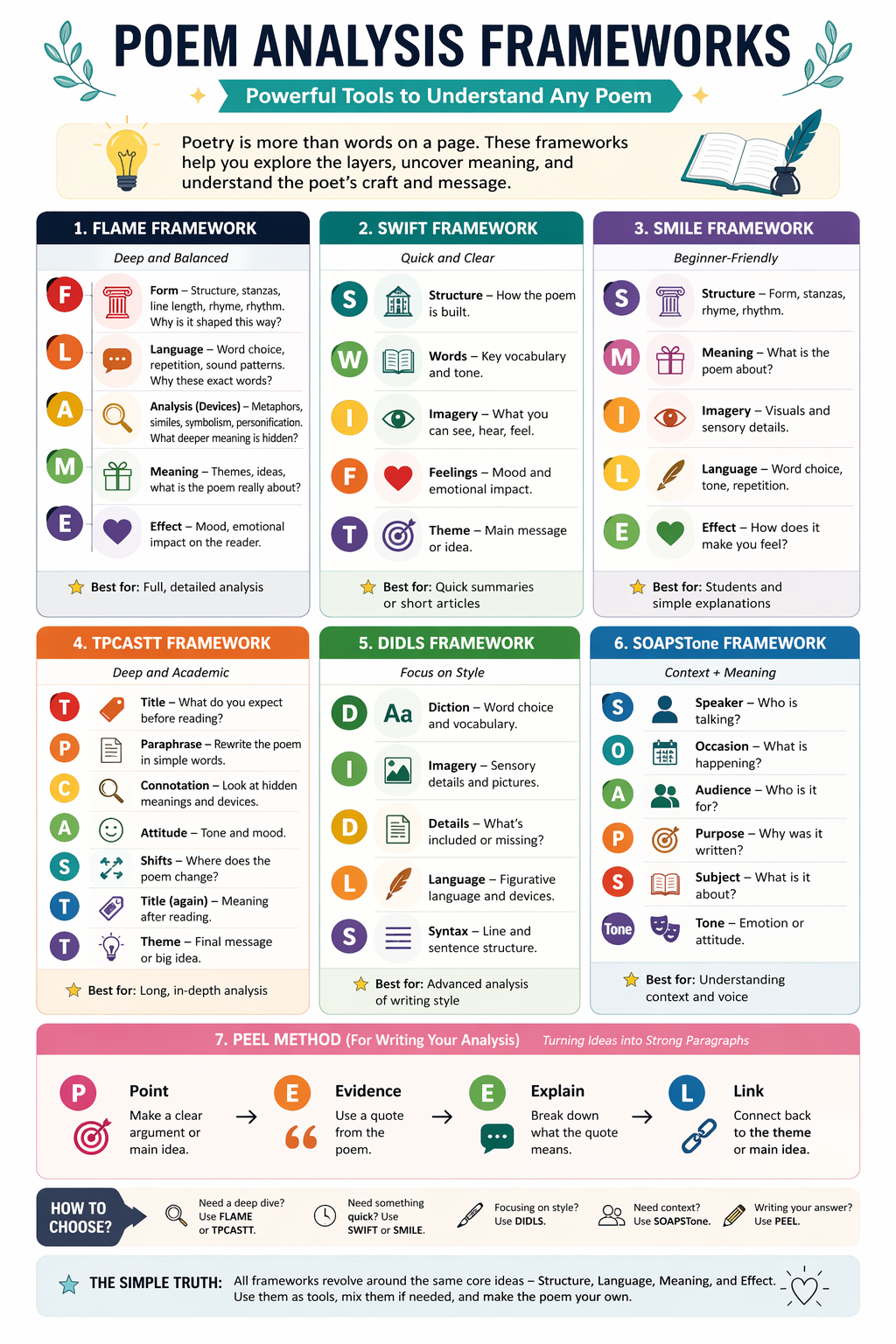
1. FLAME Framework (Deep and Balanced)
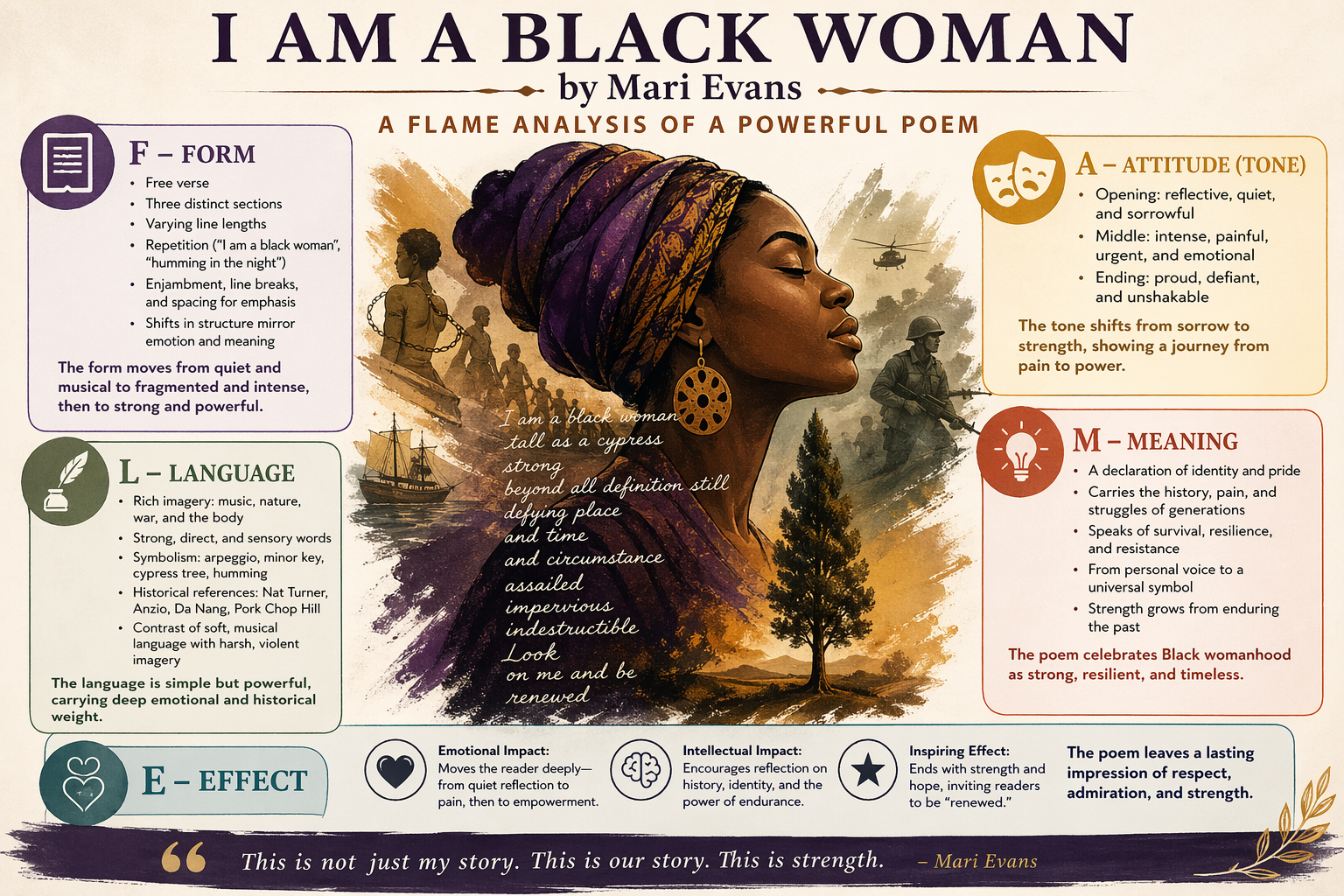
This is one of the best all-around frameworks. It covers both meaning and technique.
F — Form
Look at structure:
- Stanzas
- Line length
- Rhyme and rhythm
Ask: Why is the poem shaped this way?
L — Language
Focus on word choice:
- Repetition
- Strong or unusual words
- Sound patterns
Ask: Why these exact words?
A — Analysis (devices)
Look for literary tools:
- Metaphors
- Similes
- Symbolism
Ask: What deeper meaning is hidden here?
M — Meaning
What is the poem really about?
- Themes like love, death, time, memory
E — Effect
How does it make you feel?
- Mood
- Emotional impact
👉 Best for: Full, detailed analysis
2. SWIFT Framework (Quick and Clear)
This is a faster version, great when you want a simple breakdown.
S — Structure
How it’s built
W — Words
Key vocabulary and tone
I — Imagery
What you can see or feel
F — Feelings
Mood and emotion
T — Theme
Main message
👉 Best for: Quick summaries or short articles
3. SMILE Framework (Beginner-Friendly)
This is easy to remember and very balanced.
S — Structure
M — Meaning
I — Imagery
L — Language
E — Effect
👉 Best for: Students and simple explanations
4. TPCASTT Framework (Deep and Academic)
This one goes step by step and digs deeper.
T — Title
What do you expect before reading?
P — Paraphrase
Rewrite the poem in simple words
C — Connotation
Look at hidden meanings
A — Attitude
Tone and mood
S — Shifts
Where does the poem change?
T — Title (again)
Meaning after reading
T — Theme
Final message
👉 Best for: Long, in-depth analysis
5. DIDLS Framework (Focus on Style)
This framework zooms in on how the poem is written.
D — Diction
Word choice
I — Imagery
Sensory details
D — Details
What’s included or missing
L — Language
Figurative language
S — Syntax
Line and sentence structure
👉 Best for: Advanced analysis of writing style
6. SOAPSTone Framework (Context + Meaning)
This one looks at the bigger picture.
S — Speaker
Who is talking?
O — Occasion
What’s happening?
A — Audience
Who is it for?
P — Purpose
Why was it written?
S — Subject
What is it about?
Tone
Emotion or attitude
👉 Best for: Understanding context and voice
7. PEEL Method (For Writing Your Analysis)
This one is slightly different. It’s not for breaking down poems—it’s for writing about them clearly.
P — Point
Make your idea
E — Evidence
Use a quote
E — Explain
Break it down
L — Link
Connect back to the theme
👉 Best for: Turning ideas into strong paragraphs
How to Choose the Right Framework
Not every poem needs the same approach.
- Use FLAME → when you want a full, deep breakdown
- Use SWIFT or SMILE → when you want something quick and clear
- Use TPCASTT → when you need detailed, step-by-step analysis
- Use DIDLS → when focusing on language and style
- Use SOAPSTone → when context matters
- Use PEEL → when writing your final answer
The Simple Truth About All Frameworks
All these frameworks are built around the same core ideas:
- Structure — how the poem is built
- Language — the words and techniques
- Meaning — what it says
- Effect — how it feels
Once you understand these four, you can analyze almost any poem—even without a framework.
Final Tip
Don’t try to use every framework at once.
Start simple:
- Understand what’s happening
- Notice how it’s written
- Think about what it means
- Explain the effect
That’s already a strong analysis.