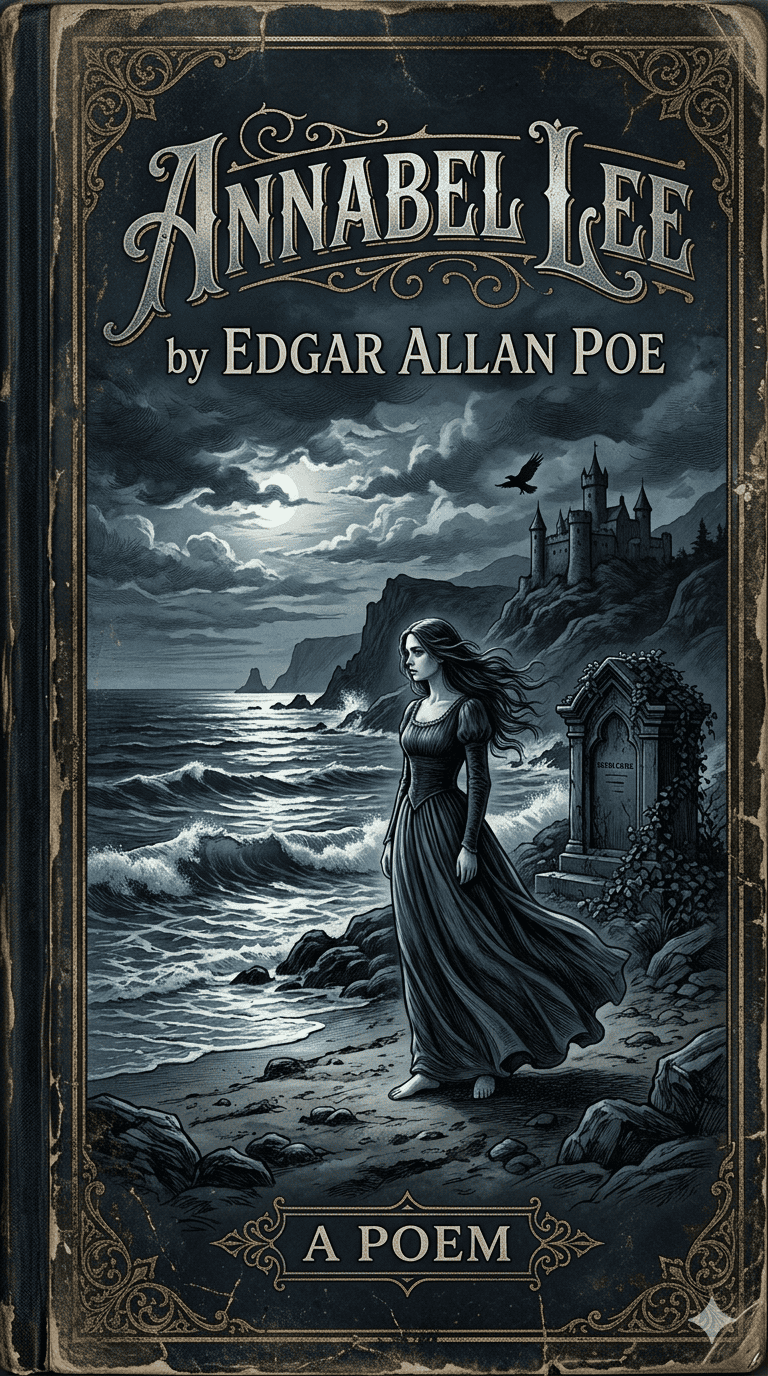
Annabel Lee by Edgar Allan Poe: Meaning, Themes, Summary & Analysis
Discover the meaning behind Annabel Lee. Wordstack breaks down Poe’s haunting poem into simple themes, summary, and analysis.

Read the poem before the analysis
It was many and many a year ago,
In a kingdom by the sea,
That a maiden there lived whom you may know
By the name of Annabel Lee;
And this maiden she lived with no other thought
Than to love and be loved by me.
I was a child and she was a child,
In this kingdom by the sea,
But we loved with a love that was more than love—
I and my Annabel Lee—
With a love that the wingèd seraphs of Heaven
Coveted her and me.
And this was the reason that, long ago,
In this kingdom by the sea,
A wind blew out of a cloud, chilling
My beautiful Annabel Lee;
So that her highborn kinsmen came
And bore her away from me,
To shut her up in a sepulchre
In this kingdom by the sea.
The angels, not half so happy in Heaven,
Went envying her and me—
Yes!—that was the reason (as all men know,
In this kingdom by the sea)
That the wind came out of the cloud by night,
Chilling and killing my Annabel Lee.
But our love it was stronger by far than the love
Of those who were older than we—
Of many far wiser than we—
And neither the angels in Heaven above
Nor the demons down under the sea
Can ever dissever my soul from the soul
Of the beautiful Annabel Lee;
For the moon never beams, without bringing me dreams
Of the beautiful Annabel Lee;
And the stars never rise, but I feel the bright eyes
Of the beautiful Annabel Lee;
And so, all the night-tide, I lie down by the side
Of my darling—my darling—my life and my bride,
In her sepulchre there by the sea—
In her tomb by the sounding sea.
"Annabel Lee" is a haunting melody written by the master of the macabre, Edgar Allan Poe. Written in 1849, it was the last complete poem he ever penned before his mysterious death. If you are looking for a story about a love that refuses to die—even when the person does—you are in the right place.
The Story Summary
The poem is told by a narrator who is looking back on a love he had "many and many a year ago."
- A Childhood Romance: The narrator and a girl named Annabel Lee grew up in a "Kingdom by the sea." They were children, but their love was so intense that the angels in Heaven became jealous.
- The Tragedy: Because the angels were envious, they sent a cold wind out of a cloud that made Annabel Lee sick. She died and was taken away by her "highborn kinsmen" (wealthy relatives) to be buried in a tomb (a sepulchre).
- Beyond the Grave: The narrator insists that their souls are tied together. He claims that neither angels nor demons can ever break their bond.
- The Haunting Finale: The narrator reveals that he cannot look at the moon or stars without seeing her eyes. In a chilling twist, he tells us that he spends every night lying down next to her tomb by the sounding sea.
Key Facts at a Glance
| Feature | Details |
| Author | Edgar Allan Poe |
| Published | 1849 (Posthumously) |
| Setting | A fictional, fairy-tale-like Kingdom by the Sea |
| Tone | Romantic, Mournful, and Obsessive |
| Main Symbol | The Sea (represents both beauty and a cold, lonely death) |
Why the Poem Sounds Like a Song
Poe was a genius at "musicality." When you read Annabel Lee, you’ll notice a "galloping" rhythm. This is created by using anapestic meter.
In 8th-grade terms, an anapest is a beat that goes: short-short-LONG.
“For the MOON / never BEAMS / withOUT BRING / ing me DREAMS”
This rhythm mimics the rising and falling of the ocean waves. Poe uses repetition (repeating "Annabel Lee" and "Sea") to make the poem feel like a chant or a prayer that he can't stop saying.
Important Vocabulary
To truly understand the "Deep Dive" into this article, you need to know these four words:
- Maiden: A young girl.
- Seraphs: High-ranking angels.
- Sepulchre: A stone room or tomb where a dead person is laid.
- Dissever: To separate or cut apart.
The Real-Life Connection
While the poem feels like a legend, it comes from a place of real pain. Poe’s young wife, Virginia Clemm, died two years before he wrote this. Like Annabel Lee, she was young and died of a "chilling" illness (tuberculosis). This poem was Poe’s way of telling the world that death didn't get to win—his love was stronger.
Stanza-by-Stanza Summary: Annabel Lee
To truly understand this poem, you have to look at it piece by piece. Poe builds the story like a staircase, starting with a sweet childhood romance and ending in a dark, lonely tomb.
Here is the breakdown of all six stanzas.
Stanza 1: The Fairy Tale Begins
The poem opens with a classic "Once upon a time" vibe. Poe tells us that "many and many a year ago," a girl named Annabel Lee lived in a kingdom by the sea.
- The Point: He wants you to know that her only goal in life was to love him and be loved by him. It’s presented as a pure, simple, and perfect world.
Stanza 2: A Love "More Than Love"
The narrator explains that they were both just children, but their feelings were grown-up and powerful.
- The Conflict: He says the Seraphs (the highest angels in Heaven) were jealous of them. Because their love was so perfect, the angels "coveted" it—which means they wanted it for themselves or wanted to ruin it.
Stanza 3: The Tragedy Strikes
This is the "turning point" of the story. A cold wind blows out of a cloud at night, "chilling" Annabel Lee.
- The Death: She dies from the cold. Her "highborn kinsmen" (her wealthy relatives) come and take her away from the narrator to bury her in a stone tomb (sepulchre) right by the ocean.
Stanza 4: The Blame Game
The narrator gets defensive here. He tells the reader that the angels weren't even half as happy in Heaven as he and Annabel Lee were on Earth.
- The Reason: He insists that everyone in the kingdom knows that the wind came out of the cloud specifically to kill his bride because the angels were so envious.
Stanza 5: An Unbreakable Bond
Even though she is buried, the narrator says the story isn't over. He claims their love is stronger than the love of people who are older or wiser than them.
- The Defiance: He says that no angel in Heaven and no demon under the sea can ever "dissever" (separate) his soul from Annabel Lee’s soul. They are permanently linked.
Stanza 6: The Chilling Conclusion
This is the most famous and creepiest part of the poem. The narrator describes how he lives his life now:
- The Moon: When it shines, it brings him dreams of her.
- The Stars: When they rise, they look like her bright eyes.
- The Twist: He reveals that every single night, he goes down to the shore and lies down next to her body inside the tomb. The poem ends with the sound of the "sounding sea," leaving us with the image of him trapped in his grief.
Summary Table
| Stanza | Mood | Key Event |
| 1-2 | Romantic / Dreamy | They fall in love; the angels get jealous. |
| 3-4 | Dark / Accusatory | Annabel Lee dies; the narrator blames the angels. |
| 5-6 | Intense / Haunting | He claims their souls are one and sleeps by her tomb. |
Key Vocabulary: The "Hard Words" of Annabel Lee
To truly get inside the head of Edgar Allan Poe, you have to understand the specific words he chose. Poe didn't just pick words because they sounded "fancy"—he picked them because they created a specific rhythm or a ghostly atmosphere.
Here are the essential terms you need to know to master this poem.
1. Maiden
- Definition: A young, unmarried girl or woman.
- In the Poem: Poe uses this to make Annabel Lee sound innocent and like a character from a fairy tale.
2. Seraphs
- Definition: The highest-ranking, highest-quality angels in Heaven.
- In the Poem: Poe claims the seraphs were jealous of his love. By using this word instead of just "angels," he’s saying that even the most holy beings in existence couldn't handle how perfect his relationship was.
3. Coveted
- Definition: To desperately want something that belongs to someone else.
- In the Poem: The angels coveted their love. This is the "motive" for the crime in the narrator's eyes.
4. Highborn Kinsmen
- Definition: "Highborn" means born into a wealthy or noble family. "Kinsmen" means male relatives.
- In the Poem: When Annabel Lee dies, her wealthy family members show up to take her away. This highlights the narrator’s loneliness—even in death, her family tries to keep her away from him.
5. Sepulchre
- Definition: A small room or monument, usually made of stone, where a dead person is buried.
- In the Poem: This is a much "darker" and "colder" word than "grave." It makes you think of a cold, stone box by the ocean.
6. Dissever
- Definition: To separate, divide, or cut into two pieces.
- In the Poem: The narrator says nothing can dissever his soul from Annabel Lee’s. It’s a very strong, violent-sounding word to show how permanent their bond is.
7. Night-tide
- Definition: An old-fashioned way of saying "nighttime" or the time when the tide comes in at night.
- In the Poem: This connects the time of day directly to the ocean. It reminds the reader that the sea is always present.
The "Glossary" Table
If you're studying for a test or writing your own analysis, keep this quick-reference table handy:
| Word | Simple Meaning | Why Poe Used It |
| Covet | Envy / Jealousy | To make the angels look like villains. |
| Kinsmen | Family members | To show people "interfering" with their love. |
| Sepulchre | Stone Tomb | To create a cold, gothic atmosphere. |
| Dissever | To split apart | To show their souls are "glued" together. |
Major Themes: Annabel Lee
Every great poem has a "big idea" hidden beneath the words. In Annabel Lee, Poe explores some very intense feelings. Since the poem is a mix of a fairy tale and a ghost story, the themes are a mix of beautiful and terrifying.
Here are the three big themes you need to know.
1. Love That Conquers Death
The biggest theme in the poem is that true love is eternal. The narrator doesn't believe that his relationship ended just because Annabel Lee died.
- The "Soul" Connection: He says that their souls are essentially one. He believes that no matter what happens in the physical world, they are still together.
- The "More Than Love" Idea: By saying their love was stronger than that of people "older and wiser," he’s arguing that young, pure love is the most powerful force in the universe.
2. Grief and Obsession
While the narrator thinks he is being romantic, many readers see a theme of unhealthy obsession.
- The "Loop" of Sorrow: The narrator is stuck in the past. He doesn't move on, find a new job, or travel. He spends his time staring at the moon and thinking about her eyes.
- The Creepy Ending: Sleeping next to a tomb is the ultimate sign of someone who has let grief take over their entire life. Poe is showing how losing someone you love can actually break your mind.
3. Man vs. The Supernatural
In this poem, the narrator doesn't think his wife died of natural causes (like a virus or a cold). He blames the Supernatural.
- The Jealous Heavens: He paints a picture where the universe is "out to get him." He views the angels not as kind helpers, but as jealous villains who stole his happiness.
- Nature as a Weapon: The "wind" and the "cloud" are seen as tools the angels used to kill Annabel Lee. This theme shows a world where humans are at the mercy of powerful, invisible forces.
Theme Comparison Table
| Theme | The "Romantic" View | The "Gothic" View |
| Love | It's a beautiful, eternal bond. | It's a dangerous, soul-crushing obsession. |
| Death | It's just a temporary physical separation. | It's a cold, permanent "sepulchre" by the sea. |
| The Angels | They are divine beings watching over us. | They are envious monsters who ruin lives. |
Symbolism Check: The Sea
The "Sea" is a huge part of these themes. In the poem, the sea represents The Unknown. It is beautiful to look at, but it is also cold, deep, and dangerous. It is where the demons live and where Annabel Lee’s tomb sits. It’s the perfect symbol for a love that is both deep and deadly.
Literary Devices Used By Edgar Allan Poe in Annabel Lee
To make a poem stick in someone’s head for over 150 years, you need more than just a good story; you need the right tools. Edgar Allan Poe used specific "literary devices" to make Annabel Lee sound like a haunting song.
Here are the tools Poe used to build this masterpiece.
1. Anapestic Meter (The Rhythm)
This is the most important device in the poem. An anapest is a poetic "foot" that has two short syllables followed by one long, stressed syllable (da-da-DUM).
- Why he used it: It sounds like the rhythm of a galloping horse or waves crashing on the beach. It gives the poem a "musical" feel that makes it easy to remember.
- Example: "For the MOON / never BEAMS / with-out BRING / ing me DREAMS"
2. Alliteration
Alliteration is when you repeat the same consonant sound at the beginning of words that are close together.
- Why he used it: It creates a "hushing" sound or a melodic flow that makes the lines feel smoother.
- Example: "That the heavenly hearts went hating her and me." (The repeating "H" sound feels like a heavy breath or a sigh).
3. Repetition (Refrain)
Poe repeats specific words and phrases throughout the entire poem, especially "Annabel Lee," "Kingdom by the sea," and "Sea."
- Why he used it: In poetry, this is often called a refrain. It creates an "echo" effect. It shows the narrator is obsessed; he can’t stop thinking about these specific things, so the words keep coming back.
4. Personification
Personification is when you give human qualities to something that isn't human.
- Why he used it: To make the universe feel like a character that is actively trying to hurt the narrator.
- Example: Poe says the wind came out of the cloud to "chill and kill" his bride. He treats the wind like a murderer with a plan, rather than just weather.
5. Hyperbole
A hyperbole is an extreme exaggeration used for emphasis.
- Why he used it: To show that their love wasn't a normal, everyday love. It was "epic" and "supernatural."
- Example: He claims their love was so great that even the angels in Heaven were jealous. This is a massive exaggeration to show how special he felt their bond was.
6. Internal Rhyme
While most poems rhyme at the ends of lines, Poe often puts rhymes inside the lines.
- Why he used it: It speeds up the reading pace and makes the poem feel more like a song or a chant.
- Example: "And the stars never rise but I feel the bright eyes" or "For the moon never beams without bringing me dreams."
Quick Device Checklist
| Device | Definition | Example from Poem |
|---|---|---|
| Alliteration | Repeated starting sounds | "brighting the beams" |
| Assonance | Repeated vowel sounds | "shining," "rising," "eyes" (The long "I" sound) |
| Imagery | Words that create a picture | "A wind blew out of a cloud by night" |
| Metaphor | Comparing without "like/as" | The "wind" as a cold killer. |
Historical Context: The Real Heartbreak
To understand why "Annabel Lee" feels so painful, you have to look at the life of the man who wrote it. Edgar Allan Poe didn't just imagine this story—he lived through a series of tragedies that made "chilling and killing" a reality in his own world.
1. The Inspiration: Virginia Clemm
Most historians believe the poem was written for Poe’s wife, Virginia Clemm. Their real-life story is just as dramatic as the poem:
- Young Love: Like the narrator and Annabel Lee, they were very young when they fell in love. Virginia was Poe's cousin, and they married when she was only 13 (which was unusual even back then).
- The Illness: Virginia died of tuberculosis, a terrible lung disease. In the 1800s, tuberculosis was often called "consumption." One of the main symptoms was a cold, shivering fever—just like the "chilling wind" in the poem.
- The Loss: Poe watched his wife suffer for five years before she died in 1847. He wrote "Annabel Lee" only two years later, while he was still deep in grief.
2. Poe’s "Beautiful Death" Theory
Poe had a very specific (and some say dark) view on art. He once wrote an essay where he said:
"The death of a beautiful woman is, unquestionably, the most poetical topic in the world."
He believed that nothing created a stronger emotional reaction than the loss of someone young and lovely. "Annabel Lee" was his final attempt to prove this theory true.
3. The "Death Trend" of the 1800s
In the mid-19th century, death was much more common in daily life than it is today.
- Gothic Romanticism: This was a popular style of writing that focused on dark emotions, ghosts, and the supernatural.
- Mourning Culture: People in 1849 were obsessed with "proper" grieving. They often wore black for years and kept locks of hair from people who had died. The narrator’s obsession with Annabel Lee’s tomb fit right in with the spooky, romantic vibes of that time.
Historical Comparison Table
| The Poem | The Real Life of Edgar Allan Poe |
| Annabel Lee | Virginia Clemm (his wife) |
| "A wind blew out of a cloud" | Tuberculosis (the "White Plague") |
| "In a kingdom by the sea" | A tiny cottage in Fordham, New York |
| The narrator lies by her tomb | Poe visited her grave constantly in the freezing cold |
4. A Mysterious Ending
The poem was published in October 1849, just a few days after Poe himself died. He was found in a confused state on the streets of Baltimore, wearing clothes that weren't his. He died in a hospital shortly after.
Because "Annabel Lee" came out right after his death, people saw it as his final goodbye to the world. It turned Poe into a legend—the tragic poet who died shortly after finishing his greatest love song.
Discussion Questions: Annabel Lee
A great poem shouldn’t just be read—it should be debated. Because Edgar Allan Poe left so much open to interpretation, there are no "wrong" answers, only different ways of seeing the story.
Use these questions to spark a conversation in the comments or to help you write your own essay.
1. The Mystery of the Angels
The narrator is 100% convinced that the angels killed Annabel Lee because they were jealous.
- Question: Do you think the angels actually did it, or is the narrator just looking for someone to blame for a natural illness?
- Deep Dive: If he blames the angels, does that mean he has lost his faith in God, or does he think his love was just "more holy" than Heaven itself?
2. Romantic Hero or Creepy Stalker?
In the 1800s, staying loyal to a dead spouse was seen as very romantic. Today, some people find the ending of the poem a bit disturbing.
- Question: Is the narrator’s decision to sleep by her tomb every night a beautiful act of loyalty, or is it a sign that he has become dangerously obsessed?
- The Debate: At what point does "grief" turn into "madness"?
3. The "Childhood" Factor
Poe emphasizes that "I was a child and she was a child."
- Question: Why does he keep mentioning their age? Does being young make their love feel more "pure," or is he trying to explain why they didn't have the "wisdom" to handle their grief better?
4. The Power of Setting
The poem takes place in a "Kingdom by the Sea."
- Question: How would the poem change if it took place in a crowded city or a quiet forest? What does the "sea" add to the feeling of the story?
Quick Poll: Pick a Side
| Side A: The Romantic | Side B: The Gothic |
| The narrator is a tragic hero who found his soulmate. | The narrator is a broken man who can't let go of the past. |
| The poem is about a love that death cannot touch. | The poem is about how grief can trap you in a dark place. |
| The ending is a beautiful promise of reunion. | The ending is a scary look at a mental breakdown. |
Writing Prompts (The "Challenge" Section)
If you want to test your brain, try answering one of these in a short paragraph:
- Perspective Swap: Write four lines of the poem from the perspective of the "highborn kinsmen" who took Annabel Lee away. How did they feel?
- Modern Remake: If this poem were a song written in 2026, what would the "Kingdom by the sea" be? A digital world? A different planet?
- The Scientific View: Explain the death of Annabel Lee using medical facts instead of "jealous angels." How does that change the mood of the poem?
Frequently Asked Questions: Annabel Lee
When people first read "Annabel Lee," they usually have the same few questions. Edgar Allan Poe left a lot of mysteries in the poem on purpose, but here are the answers to the most common things people wonder about.
1. Did Annabel Lee actually exist?
Not exactly. While there is no historical record of a woman named "Annabel Lee," the poem is widely believed to be about Poe’s wife, Virginia Clemm. However, many other women Poe knew claimed the poem was about them! It’s likely a mix of his love for Virginia and his general feelings about loss.
2. How did Annabel Lee die?
In the poem, the narrator blames a "chilling wind" sent by jealous angels. In real life, most readers interpret this as tuberculosis. In the 1800s, tuberculosis caused victims to have terrible "chills" and fevers, making the metaphor of a cold wind very realistic for the time.
3. Why is the narrator so obsessed with the angels?
The narrator is looking for a reason for his pain. By blaming the angels, he makes his love story feel more important—it wasn't just a random sickness; it was a cosmic event. It shows he believes his love was so great it actually threatened the peace of Heaven.
4. Is the narrator actually sleeping in a tomb at the end?
This is the most debated part of the poem!
- Some people think he is speaking metaphorically, meaning he spends all his time thinking about her.
- Others think Poe meant it literally, which would be a classic "Gothic" ending. Given Poe's style, the literal (and creepier) answer is usually what people go with.
5. What is the "Kingdom by the Sea"?
Poe never names a specific country. By keeping the location vague, he makes the poem feel like a legend or a myth that could happen anywhere, at any time. It’s a "placeless" setting that adds to the dream-like mood.
Quick Fact Sheet
| Question | Short Answer |
| Was she a real person? | Inspired by his wife, Virginia. |
| Who are the "kinsmen"? | Her wealthy family members. |
| What is a "sepulchre"? | A stone burial vault. |
| Is it a happy poem? | It starts as a romance but ends as a tragedy. |
6. Why does the poem rhyme so much?
Poe used a lot of internal rhyme and repetition to make the poem sound like a "dirge" (a funeral song). The rhyming words like sea, Lee, me, agree, and free keep pulling the reader back to the same sounds, just like the narrator is pulled back to the same memories.